By a technology analyst who remembers when people laughed at foldables—and who just spent a week wishing he had $2,000 to spare
Seven years ago, when the first Samsung Galaxy Fold cracked open in reviewers’ hands like a delicate pastry, the jokes wrote themselves. Foldables were a gimmick. A party trick. A $2,000 science experiment for people with more money than patience.
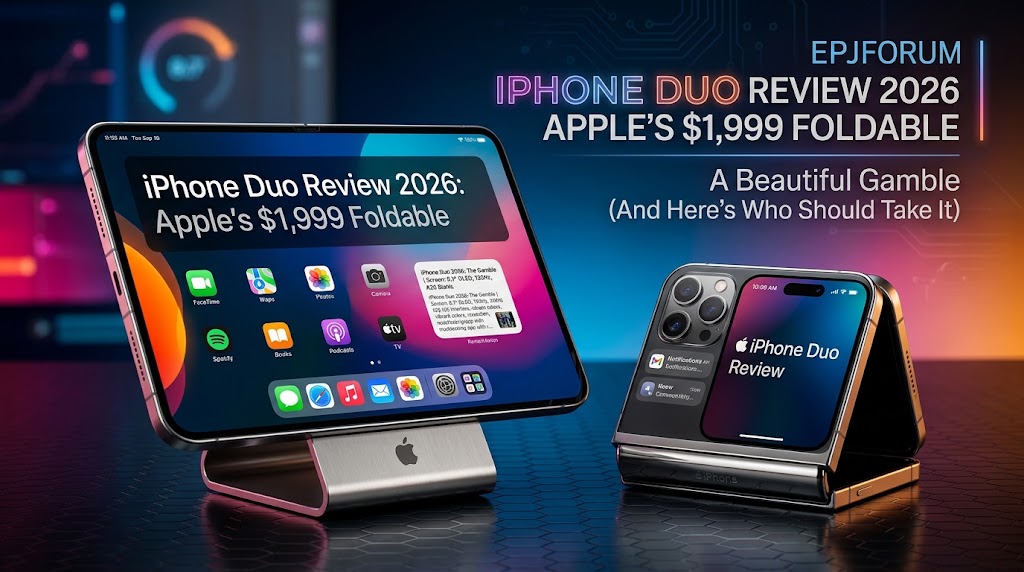
Then something funny happened. The category didn’t die. It evolved. Screens got tougher. Hinges got smarter. Prices crept downward—slowly, grudgingly, but downward. And now, in the fall of 2026, Apple has finally shown up to the party with the iPhone Duo, a $1,999 book-style foldable that asks a simple question: Would you rather have one big phone, or one small phone that becomes a big phone when you need it?
That question is not rhetorical. It’s the entire thesis of this product, and the answer depends entirely on who you are.
I’ve spent the past week digging through hands-on reviews, spec sheets, repair cost breakdowns, and retail listings to give American buyers the straight story. And here’s the short version: the iPhone Duo is the most interesting iPhone in years, but it’s not the best iPhone you can buy right now. Whether that matters depends on what you value more—a flagship that does everything, or a glimpse of the future that does most things beautifully.
Let’s break it down.
The iPhone Duo does something clever that most foldables haven’t tried. Instead of taking a big phone and making it bigger, Apple built a small phone that unfolds into a big one.
Closed, the Duo is roughly the size of a wallet—about 11.3mm thick, which is chunky but not absurd for a foldable. It fits in a front pants pocket without feeling like you’re carrying a paperback novel around . Open, you get a 7.6-inch inner display with a matte nano-texture polymer finish that cuts glare, hides the crease better than most competitors, and feels almost paper-like under a finger or an Apple Pencil (USB-C only, and yes, support for annotations arrived post-launch in iOS 27.2) .
The hinge deserves genuine praise. It’s firm, sturdy, holds at almost any angle, and closes with a magnet-assisted click that feels engineered rather than accidental. Opening the phone is a two-handed affair—that’s just physics with a screen this size—but once it’s open, reviewers found it no more cumbersome to hold one-handed than an iPhone 18 Pro Max. At 254 grams, it’s technically Apple’s heaviest iPhone, but the difference from the Pro Max is only five grams .
There’s Ceramic Shield glass and IP68 dust and water resistance, which is genuinely impressive for a device with moving parts. But reviewers were candid: with a flexible screen and a $2,000 price tag, you’ll be more conscious of how you handle this phone than a regular slab iPhone. Apple’s cases add bulk, and skipping a case feels like a dare.
One design choice that raised eyebrows: no Face ID. The Duo uses Touch ID built into the power button, like some iPads. It’s fast and responsive, but reviewers noted they genuinely missed facial recognition, and you’ll want to register as many fingerprints as iOS will allow since you’ll be tapping from all sorts of angles depending on how the phone is folded .
Also odd: when closed, the volume buttons are on the top edge. That’s an awkward placement during a phone call. Small thing, but you’ll notice it every time.
Here’s where the iPhone Duo earns its price tag.
The 7.6-inch inner display is, by all accounts, stunning. The matte texture—Apple calls it nano-texture polymer—does double duty: it softens the crease line and kills reflections, making outdoor reading genuinely pleasant even in direct sunlight . One reviewer described reading outside as “problem-free” despite direct sun, which is not something you can say about most glossy foldable screens.
The software adapts intelligently to the form factor. In landscape, the home screen organizes itself like two iPhones side by side. Partially fold the Duo, and the two halves of the display bias away from the hinge—a nice touch. In portrait, it’s more like a centered iPhone home screen with spacious margins down either side. Open an app on the outer screen and unfold, and it maximizes to fill the inner display. Two apps can run side by side by swiping up and dragging, though dual-app support only works in landscape orientation .
What Apple doesn’t offer is Samsung-style app pair pinning—the ability to save two apps as a linked pair and open them together with one tap. That’s a genuine productivity gap, and one that power users coming from Galaxy Z Fold devices will notice immediately.
The outer 5.4-inch display is the surprise star of the review. Reviewers expected it to feel laughably tiny. Instead, the short, wide aspect ratio proved far more usable than the taller, narrower 5.4-inch panel of the old iPhone 13 mini. Part of that is psychological—knowing you can unfold changes how you interact with the closed phone—and part of it is that the shape is simply better for thumb typing and quick glances.
Under the hood, the iPhone Duo is every bit the modern flagship. It runs the A20 Pro chipset with the same speed and thermal improvements as the iPhone 18 Pro line. You get the latest Siri AI, Messages via Satellite, 5G, eSIM, Bluetooth 6, and Wi-Fi 7 . Battery life is rated at up to 24 hours of typical use from dual batteries, and one reviewer ended a heavy day with about half the charge remaining—which is genuinely impressive for a foldable.
The problem isn’t hardware. It’s software.
Apple’s own apps lead the charge. Mail and Messages use the larger inner screen to show a list and preview side by side. A pre-release version of Slack offered a desktop-like layout. Darkroom, the photo editor, takes good advantage of the extra real estate .
But a lot of apps—Bluesky, Gmail, Google Voice—float in a sea of black, unused display. You can magnify them in portrait mode to fill more of the screen, but that’s just bigger, not better. It’s the classic early-adopter problem: the hardware is ready, the software isn’t. And it will get better. Developers will update. But if you buy an iPhone Duo on day one, you’re buying a promise as much as a product.
Let’s be blunt: the iPhone Duo’s cameras are not the best Apple makes.
You get a pair of Fusion sensors—a 48MP main and a 48MP ultra-wide—on the outside. What you don’t get is the variable aperture magic of the iPhone 18 Pro Max, or the dedicated telephoto that gives Pro phones their 4x optical zoom. The Duo promises 2x optical-quality zoom and then software-magnifies up to a fairly crunchy 10x .
For casual shooters, that’s fine. The main cameras produce images “much akin to those from last year’s iPhone 17 Pro, telephoto sensor aside,” and Apple’s night photography remains tasteful—it doesn’t wildly over-brighten scenes the way some rivals do, so you can still tell it’s nighttime . The internal FaceTime camera, which cleverly peeks through the pixels of the inner display, is perfectly sufficient for video calls. But for selfies, use the far-better camera cut into the external screen. It’s sharper and clearer.
The bottom line: if you’re a zoomer—optically, not generationally—you’ll miss the telephoto. If you shoot mostly wide and ultra-wide, you’ll be happy.
Battery life is a pleasant surprise. Apple claims 24 hours of typical use, and reviewers were skeptical until they actually used the phone. One ended a heavy day with about half the battery left despite showing “no restraint.” The Duo sticks to a MagSafe desk stand when folded, though it droops when unfolded—a small physical quirk of the form factor.
Then there’s repair pricing, and this is where the iPhone Duo’s $1,999 sticker price starts to look like the cheap part.
| Repair | Cost |
|---|---|
| Outer display replacement | $379 (same as iPhone 18 Pro Max screen) |
| Inner display replacement | $999 |
| “Other damage” (assume hinge included) | $1,499 |
| Matte inner screen protector swap | $49 |
*Source: *
That inner display number deserves a moment of silence. $999 to replace the folding screen is half the cost of the phone itself. The blanket $1,499 “other damage” charge—which almost certainly covers hinge repairs—is more than most people’s monthly rent. AppleCare+ becomes less of an optional add-on and more of a mandatory subscription if you’re buying this phone.
Now the part every American buyer scrolls to. Let’s put the iPhone Duo next to its most obvious competitors on US retail shelves.
| Device | Starting Price | Storage | Key Trade-off |
|---|---|---|---|
| iPhone Duo | $1,999 | 256GB | Foldable form factor, Touch ID, no telephoto |
| iPhone Duo (maxed) | $3,199 | 2TB | MacBook Pro territory |
| iPhone 18 Pro Max | $1,299 | 256GB | Better cameras, Face ID, no folding |
| Samsung Galaxy Z Fold 8 | ~$1,899–$2,000 | 256GB | Mature foldable software, stylus support |
| Google Pixel 11 Pro Fold | ~$1,799–$1,899 | 256GB | Best-in-class AI features, Tensor chip |
| OnePlus Open 2 | ~$1,699 | 256GB | Value foldable, aggressive pricing |
*Price data compiled from *
The pricing story is simple and uncomfortable: the iPhone Duo costs $700 more than the iPhone 18 Pro Max, and for that $700 you get a folding screen, a worse camera system, and the loss of Face ID. Reviewers were blunt about this: “It’s tough to make an argument that most iPhone users should stretch beyond the iPhone 18 Pro” .
The $3,199 maxed-out 2TB model is genuinely MacBook Pro money. Unless you’re a professional who needs maximum local storage on a pocketable device—and who is also willing to gamble on first-generation foldable hardware—that configuration is hard to justify.
Where the Duo does compete is against other foldables. At $1,999, it’s priced in line with the Galaxy Z Fold 8 and slightly above the Pixel 11 Pro Fold. But those devices run Android, and the single biggest reason iPhone owners haven’t switched to foldables is iOS. As one reviewer put it, “iPhone owners just don’t like giving up iOS” . That factor alone means the Duo’s main competition isn’t Samsung or Google—it’s Apple’s own iPhone 18 Pro Max.
Availability: The iPhone Duo is sold directly by Apple and through all major US carriers—Verizon, AT&T, T-Mobile—as well as retailers like Best Buy and Amazon. Carrier trade-in deals can knock several hundred dollars off the sticker price, so check those before buying outright. Apple rarely discounts first-party hardware at launch, so don’t expect meaningful sales until at least mid-2027.
It depends entirely on what you value. If you want the best camera system, the most streamlined security (Face ID), and the widest app compatibility, the iPhone 18 Pro Max at $1,299 is the better buy for most people. If you’ve been waiting for an iOS foldable and you have the budget to be an early adopter, the Duo delivers great hardware, a beautiful screen, and a form factor that genuinely changes how you use a phone. Just go in knowing the software is still catching up .
No. The iPhone Duo uses Touch ID built into the power button, similar to some iPad models. Reviewers noted they missed facial recognition, and you’ll want to register multiple fingerprints since you’ll be unlocking from different angles depending on how the phone is folded .
The inner folding display costs $999 to replace. The outer display is $379, same as an iPhone 18 Pro Max screen. “Other damage”—which likely includes the hinge—carries a blanket $1,499 charge. The matte inner screen protector can be swapped for $49. AppleCare+ is strongly recommended .
It has a 48MP main and 48MP ultra-wide on the outside. There’s no dedicated telephoto lens, so you get 2x optical-quality zoom and software magnification up to a fairly soft 10x. Image quality is comparable to last year’s iPhone 17 Pro, minus the telephoto. For selfies, use the external camera—it’s better than the internal FaceTime camera .
Apple’s own apps lead the way—Mail and Messages show list-plus-preview layouts, and a pre-release Slack build offered a desktop-like experience. Darkroom takes advantage of the extra space. But many third-party apps—Bluesky, Gmail, Google Voice—still float in a sea of black, unused display. This will improve over time, but early adopters will be waiting .
Yes, but only the USB-C Apple Pencil. Support for annotations and similar features was added post-launch in iOS 27.2. You’ll notice the Pencil nib crossing the crease, but the matte texture makes writing feel more paper-like than a glossy screen would .
The Galaxy Z Fold 8 runs Android, has more mature foldable software (including app-pair pinning, which the Duo lacks), and costs roughly the same. But if you’re entrenched in the Apple ecosystem—iMessage, iCloud, Apple Watch, AirPods—switching to Android is a bigger deal than any hardware difference. The Duo’s real competitor is the iPhone 18 Pro Max, not Samsung .
It has IP68 dust and water resistance, which is impressive for a device with a hinge and a flexible screen. That means it can survive accidental dunks and dust exposure, but reviewers still recommend treating it more gently than a slab iPhone given the repair costs .
There’s no firm timeline. Apple’s own apps are already optimized, and major developers are expected to follow throughout 2027. But foldable-optimized apps have been slow to arrive on Android too, so don’t expect a overnight transformation. If you buy a Duo, you’re buying into a platform that will improve—but you’ll be waiting .
Sort of. Reviewers found themselves considering a compact Bluetooth keyboard and leaving their laptop behind on short trips. Browsing, reading, watching video, and handling email and Slack are all more pleasant on the 7.6-inch screen. But it’s smaller than an iPad mini, and without app-pair pinning or a desktop-class browser, it’s not a laptop replacement for most people. It’s a phone that can do more—not a computer that fits in your pocket.
The iPhone Duo is a genuinely exciting product. It’s fun. It’s different. In a tech world that’s spent the last few years over-promising on AI and under-delivering on surprise, a foldable iPhone feels like a throwback to the days when hardware could still make you smile.
But excitement and value are different things.
For most American iPhone buyers, the math doesn’t work. The iPhone 18 Pro Max at $1,299 has better cameras, Face ID, the same chipset, and a screen that every app in the App Store already knows how to use. It’s the all-rounder. It’s the safe choice. And in a year where AI features are still maturing and foldable software is still catching up, safe has a lot going for it.
For early adopters with the budget, the iPhone Duo delivers. The inner display is Apple’s best screen. The hinge is sturdy. The battery life is genuinely good. The form factor changes how you use a phone in ways that are hard to explain until you’ve lived with it. And there’s a real joy in being part of the first wave—the same joy iPad buyers felt in 2010, before the apps caught up.
The iPhone Duo isn’t a flagship replacement. It’s flagship adjacent. It’s Apple saying: We’re in this category now. The hardware is ready. The software will follow.
Whether you buy one today or wait for the second generation is a question of patience and budget. But one thing is certain: the foldable phone isn’t a gimmick anymore. Apple just made that official.
This article is for informational and editorial purposes only. Information regarding the iPhone Duo, its specifications, pricing, repair costs, and software features is based on hands-on reporting from SlashGear and other verified sources, accurate as of October 2026. The author is not affiliated with Apple Inc., Samsung, Google, or any carrier mentioned. No compensation was received for this article. Pricing varies by retailer, carrier promotions, trade-in offers, and storage configuration; always verify current pricing before purchasing. Repair costs are based on Apple’s published service pricing and may change. Feature availability, including Apple Pencil support and app optimization, depends on software updates and third-party developer adoption and is subject to change. Some retailer links may be affiliate links, which means we may earn a small commission if you buy through them—at no extra cost to you. All opinions expressed are based on published reviews, official specifications, and independent analysis. Reader discretion is advised for anyone tempted to spend $3,199 on a phone—your MacBook is judging you.
Target SEO Keywords & Tags: iPhone Duo review, iPhone Duo price, Apple foldable iPhone, iPhone Duo vs iPhone 18 Pro Max, iPhone Duo repair cost, iPhone Duo camera review, iPhone Duo battery life, foldable iPhone 2026, iPhone Duo vs Galaxy Z Fold 8, iPhone Duo vs Pixel 11 Pro Fold, is iPhone Duo worth it, iPhone Duo specs, iPhone Duo inner display, iPhone Duo Touch ID, iPhone Duo Apple Pencil, best foldable phone 2026, iPhone Duo carrier deals, iPhone Duo 2TB price, Apple first foldable, foldable iPhone pros and cons, iPhone Duo app compatibility, iPhone Duo hinge durability, iPhone Duo IP68, iPhone Duo Precision Finding, iPhone Duo vs iPad mini, iPhone Duo for productivity, Apple foldable release date, iPhone Duo review 2026, foldable phone buying guide, iPhone Duo AppleCare




Leave a comment