By a technology analyst who actually reads the spec sheets (and the footnotes)
Let’s cut through the noise for a second. If you’ve shopped for a wireless microphone system in the past eighteen months, you know the drill. Black rectangles. Generic logos. A receiver that looks like a tiny walkie-talkie. They all work fine, but they’re about as exciting as a beige rental car.
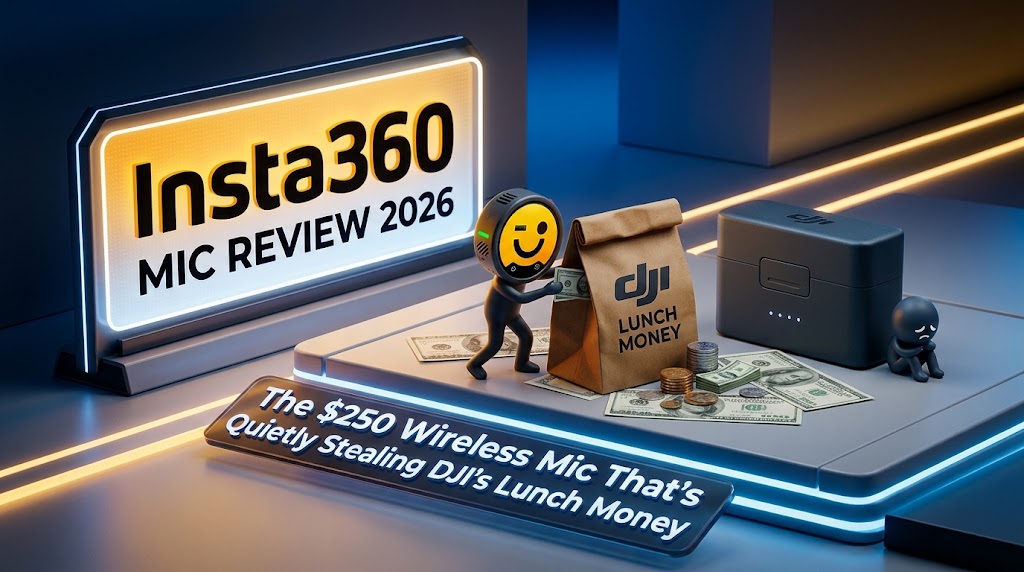
Then Insta360 did that thing it does. The company that made 360 cameras mainstream and then decided to make action cams and then decided to make wireless lavalier mics just dropped the Insta360 Mic—a $249.99 kit that sits right between the flagship $330 Mic Pro and the budget Mic Air . And it brought a customizable color E-Ink screen to the party.
I’ve spent the better part of a week digging through reviews, spec sheets, and retailer listings to answer one question for American creators: Is this the best value wireless microphone for YouTube, TikTok, podcasts, and run-and-gun interviews in 2026?
The short answer: It might be. The longer answer involves a microSD slot that’s secretly the smartest feature here, a missing triple-mic array you probably won’t miss, and a price war that’s making DJI and Rode sweat just a little.
Let’s get into it.
Here’s the thing about the Insta360 Mic E-Ink display. When the Mic Pro launched earlier this year with that 1.22-inch six-color screen, a lot of people rolled their eyes. “Who needs a screen on a lav mic?” they said. “Just give me clean audio.”
And then they saw their YouTube channel logo sitting on their chest during a shoot, and the eye-rolling stopped.
The customizable E-Ink display on the Insta360 Mic works exactly like the Pro version. You pair the transmitter to the Insta360 app, upload a JPEG or PNG—your logo, your handle, a picture of your dog, whatever—and it loads onto the screen in about thirty seconds. Once it’s there, it stays there without draining battery because E-Ink only uses power when it changes . It’s the same tech behind your Kindle, just repurposed for personal branding.
Is it essential? No. Is it viral-content bait for creators who want their gear to look as polished as their thumbnails? Absolutely. Reviewers have noted that the screen opens up “creative and even interactive options to drive engagement with your audience if you make videos for YouTube and social media” . Translation: viewers notice it. And in a crowded algorithm, being noticed is half the battle.
The transmitters themselves weigh 19.4 grams—slightly lighter than the Mic Pro’s 19.7 grams, which is a rounding error you’ll never feel . They’re bigger than DJI’s tiny Mic 3 transmitters, yes. But they’re not obnoxiously large, and the clip-and-magnet mounting system is flexible enough for t-shirts, jackets, or a discreet lapel placement.
Bottom line on design: If you want invisible, go DJI. If you want distinctive, Insta360 is your only real option.
Let’s get the boring-but-important stuff out of the way. The Insta360 Mic audio quality is, by all accounts, inherited directly from the Mic Pro. Same 48kHz recording, same AI noise-canceling chip, same voice tone presets.
Engadget’s reviewer—a self-described “mumbling Brit”—found that default settings and the voice mode delivered clear audio even for someone prone to swallowing their words. The Rich voice preset adds presence for podcasting, while the Bright preset helps voices cut through ambient noise outdoors . The AI noise cancellation is powered by a dedicated NPU chip, and reviewers consistently flag it as some of the best in class. One tester called it “hands down the best of any mic I’ve tested” .
What you don’t get on the regular Mic is the Pro’s three-capsule array. The Pro lets you switch between omnidirectional, cardioid, super-directional, and figure-8 pickup patterns. The regular Mic is omnidirectional only .
Here’s my honest take as someone who’s tested a dozen of these systems: unless you’re recording in a specifically challenging acoustic environment where directional pickup matters—like a noisy conference floor where you need to reject sound from the sides—you will not miss the extra patterns. Omnidirectional is the default for a reason. It’s forgiving. It captures the room. For 90% of YouTube creators, vloggers, and podcasters, omni is what you want.
The automatic gain control deserves a shoutout too. Two modes—Auto and Dynamic—manage levels on the fly to prevent clipping when someone laughs too loud or whispers too quiet. Combined with 32-bit float internal recording (more on that in a second), you’d have to actively try to ruin a take.
This is where the Insta360 Mic gets genuinely interesting for working creators.
The Mic Pro has 32GB of built-in storage for backup recording. The regular Mic strips that out and replaces it with a microSD card slot . On paper, that sounds like a downgrade. In practice, it’s arguably an upgrade.
Here’s why: 32GB fills up. It just does. If you’re shooting a multi-day event, a long-form documentary interview, or a wedding where you absolutely cannot ask the couple to “hold that kiss for a second while I offload footage,” built-in storage becomes a constraint. With a microSD slot, you buy a 128GB card for twenty bucks and record for days. Swap cards mid-shoot without touching a laptop.
The slot enables 32-bit float recording on the transmitter itself, which captures a massive dynamic range so that audio recorded too hot or too quiet can be salvaged in post . A 32GB card holds roughly 45 hours of 32-bit float audio . That’s not a backup feature. That’s a primary recording solution.
The catch? You have to buy the card separately. Without one inserted, there’s no internal recording at all—just wireless transmission to your camera or phone. If the wireless link drops, you lose the take . So factor an extra $15–$25 into your budget. Even with that, the $250 kit undercuts the $330 Mic Pro by enough to make the math work.
If you already own an Insta360 camera—an X5, X6, Ace Pro 2, Luna Ultra, or GO Ultra—the Mic becomes a no-brainer in a way that’s hard to overstate.
Insta360 Direct Connect pairs the transmitter to compatible cameras over Bluetooth, no receiver required. That means you can clip a mic to your collar, hit record on your X5, and get clean 48kHz audio without a dongle dangling off your rig . The range drops from the receiver’s claimed 400 meters to about 100 meters in direct-connect mode, but for vlogging and solo shooting, that’s plenty.
For everyone else, the receiver is a chunky little USB-C dongle that connects to phones, cameras, and laptops. It’s not the sleekest design—Engadget calls it “pretty chonky and looks conspicuous on a small camera or phone” —but it works. And the system supports up to four transmitters on one receiver, with the ability to mix Mic and Mic Pro transmitters on the same receiver. A four-person podcast setup using the $250 Mic kit plus two $80 spare transmitters costs about $410, versus $529 for the equivalent Mic Pro four-transmitter kit .
Multi-camera shooters get a hidden gem too: two transmitters can send synchronized audio to up to four receivers simultaneously. If you’re running an A-cam and B-cam, you can bake clean audio into both angles and skip the sync step in post entirely . That’s a workflow improvement that saves real time on every edit.
Battery specs are where the regular Mic quietly embarrasses its more expensive sibling.
| Spec | Insta360 Mic | Insta360 Mic Pro |
|---|---|---|
| Transmitter battery | 13 hours | 10 hours |
| With charging case | 34 hours | 30 hours |
| Fast charge | 80% in ~22 min | 80% in ~24 min |
| Transmitter weight | 19.4g | 19.7g |
| Internal storage | microSD (sold separately) | 32GB built-in |
| Pickup patterns | Omni only | Omni, cardioid, super-cardioid, figure-8 |
*Sources: *
Thirteen hours per transmitter is genuinely all-day battery life for most shoots. Add the charging case and you’re looking at 34 hours total, which covers a weekend wedding, a multi-day conference, or a very ambitious vlog marathon. The five-minute fast charge gives you roughly 1.5 to 2.3 hours of use, depending on which spec sheet you read . Either way, it’s enough to rescue a dead mic between takes.
Here’s the part every budget-conscious creator scrolls to. Let’s put the Insta360 Mic next to its most obvious competitors on US retail shelves.
| System | Kit Price (2TX + 1RX) | Internal Recording | Screen | Key Trade-off |
|---|---|---|---|---|
| Insta360 Mic | $249.99 | microSD (32-bit float) | Color E-Ink | Omni pickup only |
| Insta360 Mic Pro | $329.99 | 32GB built-in | Color E-Ink | More expensive |
| DJI Mic 3 | ~$259 (often discounted) | Yes | No | Smaller transmitters, ecosystem lock-in |
| Rode Wireless GO Gen 3 | ~$199–$229 | 32GB+ | No | No charging case in base kit |
| Rode Wireless PRO | ~$299+ | 32GB | No | Includes lavaliers, timecode |
| Hollyland Lark Max 2 | ~$300 | Yes | Yes (LCD) | Bulkier, different workflow |
| Hollyland Lark M2 | ~$70–$100 | Limited | No | Budget king, but fewer features |
*Price data compiled from *
The $250 price point is aggressive. It undercuts the Mic Pro by $80 while adding battery life and expandable storage. It sits right around DJI Mic 3 territory, but DJI’s US availability has been spotty, and the Mic 3 lacks the E-Ink customization . Rode’s Wireless GO Gen 3 is cheaper in some listings, but you don’t get a charging case at that price, and the transmitters are visually larger .
The value calculus shifts depending on what you already own. If you’re deep in the DJI ecosystem—Osmo Pocket, Osmo Action—the Mic 3’s proprietary connection might keep you in camp. If you’re an Insta360 camera owner, the Direct Connect feature alone justifies the Mic. And if you’re starting from scratch with a phone and a dream, the Mic’s combination of screen, SD recording, and 34-hour battery is a genuinely compelling package.
One caveat: Hollyland’s Lark M2 at $70–$100 is staggeringly cheap and popular for a reason. If your budget is genuinely tight and you just need two mics and a receiver that work, it’s hard to argue with the price . But you’re giving up the screen, the SD recording, the AI noise cancellation, and the battery life. The Insta360 Mic is a buy-once, cry-once purchase in a way the Lark isn’t.
For most YouTube creators in 2026, yes. The combination of customizable E-Ink branding, reliable AI noise cancellation, 32-bit float backup recording via microSD, and 34-hour battery life covers the three things that actually matter: clean audio, visual personality, and not running out of juice mid-shoot. The $250 kit is priced competitively against DJI and Rode while offering a feature set neither matches at that price point.
Yes, via the included USB-C receiver or through Bluetooth direct connection to third-party apps. The receiver connects to phones with USB-C, and Insta360 sells Lightning adapters for older iPhones. Direct Bluetooth pairing to phones works with third-party recording apps, though the experience is more limited than pairing to an Insta360 camera .
Yes. Without a card, the Mic functions as a standard wireless lav system—audio transmits to your camera or phone through the receiver or Bluetooth. You just don’t get internal backup recording. If the wireless signal drops, there’s no safety net. For critical shoots, a microSD card is strongly recommended .
The DJI Mic 3 has smaller, more discrete transmitters and tighter integration with DJI’s ecosystem (Osmo cameras, etc.). The Insta360 Mic counters with the customizable E-Ink screen, a microSD slot for unlimited backup recording, and longer battery life. Audio quality is comparable—both are excellent for the price. The choice often comes down to which camera ecosystem you’re already invested in.
E-Ink displays are inherently low-power and don’t suffer from burn-in the way OLED screens can. The screen is covered by the transmitter housing, and reviewers haven’t reported durability issues. It’s not indestructible—no mic is—but the E-Ink tech is well-proven from e-readers. The image persists indefinitely without power, which means your logo stays visible throughout a full shoot day .
Insta360 claims 400 meters (1,312 feet) with the receiver in ideal conditions. Reviewers have tested it at close to that range in open fields with line-of-sight and found it reliable, with occasional drops when obstructions (trees, bodies, buildings) intervene . In Direct Connect mode to an Insta360 camera, range drops to about 100 meters (328 feet) . For 99% of creators, both figures are more than enough.
Yes. One receiver supports up to four transmitters simultaneously, and you can mix regular Mic transmitters with Mic Pro transmitters on the same receiver. Each transmitter can be labeled on its E-Ink screen (Speaker 1, Speaker 2, etc.) for easier identification during editing. True four-channel discrete output requires a compatible Sony camera with Insta360’s adapter, but stereo pairing is available on other setups .
Absolutely. The receiver connects to any camera with a 3.5mm audio input (via adapter) or USB-C. It also works with laptops and phones. The E-Ink screen and SD recording work independently of the camera brand. You don’t need an Insta360 camera to use the Mic—you just miss out on the receiver-free Direct Connect convenience if you don’t have one.
Here’s the uncomfortable truth for anyone who bought the Insta360 Mic Pro earlier this year: the regular Mic is arguably the better buy for most people.
You lose the triple-capsule array (which most creators never touch), the 32GB built-in storage (which fills up), and the $80 premium (which stays in your pocket). You gain three extra hours of battery per transmitter, the flexibility of swappable microSD storage, and the exact same E-Ink customization and AI noise cancellation that made the Pro a standout .
The competitive landscape is real. DJI’s Mic 3 is a fantastic system with smaller transmitters. Rode’s Wireless GO Gen 3 is a proven workhorse. Hollyland’s Lark M2 is dirt cheap and surprisingly good. But none of them give you a screen that makes your mic yours. None of them let you swap a $20 SD card to record 45 hours of 32-bit float backup audio. And none of them offer the same seamless Direct Connect experience if you’re already shooting on an Insta360 camera.
For American creators who want a wireless mic system that performs at a professional level, looks distinctive on camera, and doesn’t require a second mortgage—the Insta360 Mic at $249.99 is the sweet spot. It’s not the cheapest. It’s not the most invisible. But it’s the one you’ll actually enjoy using.
And in a world of boring black rectangles, that counts for something.
Rating: 8.5/10
This article is for informational and educational purposes only. Product prices, specifications, and availability are accurate as of the publication date (October 2026) and are subject to change by manufacturers and retailers. The author is not affiliated with Insta360, DJI, Rode, Hollyland, or any other brand mentioned in this article. No compensation was received for this review. Always verify product details and compatibility with your specific equipment before making a purchase. Some retailer links may be affiliate links, which means we may earn a small commission if you buy through them—at no extra cost to you. All opinions expressed are based on published reviews, official specifications, and independent analysis.




Leave a comment