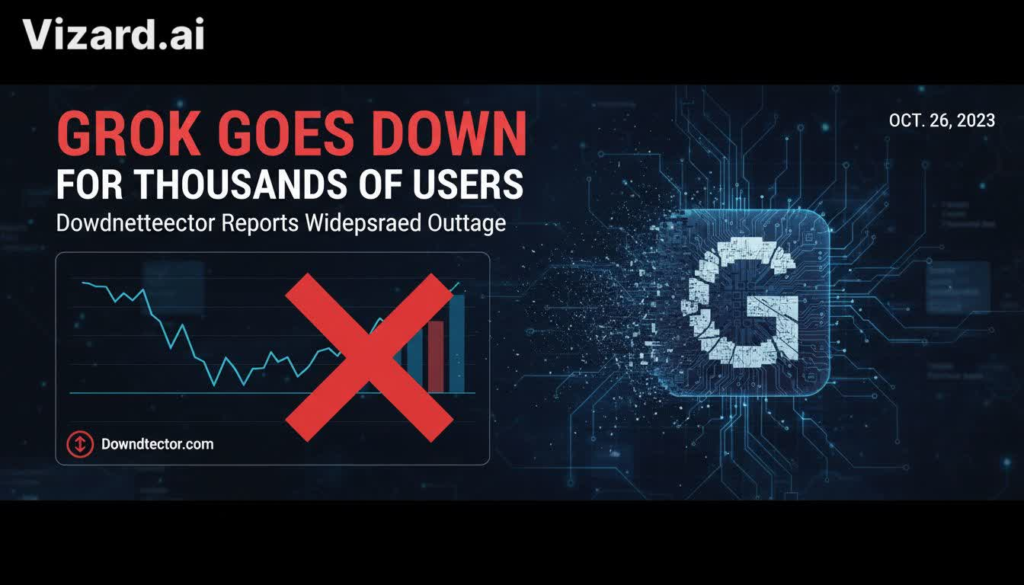
It began with a frustrated tweet. Then another. Within minutes, social media platforms were flooded with a digital chorus of confusion and annoyance: “Is Grok down for anyone else?” The unofficial pulse-check of the internet, Downdetector, confirmed the worst—its graph spiked like a seismograph detecting an earthquake. Thousands of users across the United States reported a complete service blackout of Grok, Elon Musk’s rebellious, “based” answer to ChatGPT. For an AI that prides itself on real-time knowledge and unfiltered sass, the silence was deafening. This wasn’t just a minor server hiccup; it was a full-scale platform collapse that laid bare a profound, unspoken truth of our digital era: we have woven generative artificial intelligence so deeply into our daily workflows, creative processes, and even our social interactions, that its sudden absence feels like a cognitive power outage. This blog post dissects the Grok outage, explores what it means for the future of AI reliability, and provides a crucial survival guide for navigating a world where our digital assistants can—and will—abandon us without warning.
Downdetector is not an official monitoring tool; it is a crowd-sourced symptom checker for the internet’s health. Users visit the site or use its app to report problems with services. When the Grok outage map lit up like a Christmas tree, with clusters of reports spanning from New York to California, it painted a clear picture of a widespread, systemic failure.
While exact internal root cause analyses from xAI remain private, the Downdetector data and user reports allow us to reconstruct the crisis:
| Symptom | Percentage of Reports | What It Likely Meant |
|---|---|---|
| “Server Connection” Errors | ~50% | Users’ devices could not establish a handshake with Grok’s core servers. Root cause: overloaded servers, DNS failure, or a critical backend service crash. |
| “Total Blackout” / “App Not Loading” | ~30% | The front-end (website or app) was completely inaccessible. Points to a failure in the load balancers or content delivery network (CDN) that routes traffic. |
| “Slow Response” / “Timeout” Errors | ~15% | Servers were online but so overwhelmed with requests or stuck in computational loops that they couldn’t respond in time. |
| “Login Failed” / “Authentication Errors” | ~5% | Specific identity and access management (IAM) systems failed, preventing verified users from accessing their accounts even if parts of the service were up. |
For many, especially X Premium+ subscribers who pay for access, Grok is not a toy. It has become integral to daily operation.
Neuroscience shows we adapt to tools as extensions of our own cognition. An AI outage triggers a form of digital learned helplessness. The mental shortcut you relied on is gone, forcing a frustrating reversion to slower, manual processes. This creates anxiety and lost productivity, quantified in real dollars for busines AI productivity tools, content creation with AI, developer AI assistants, real-time data analysis, cognitive offloading, digital dependency psychology, business process automation.
While xAI has not released a full post-mortem, major cloud service outages typically stem from a few critical failures.
A single erroneous software deployment or configuration change can trigger a chain reaction. Imagine an update to Grok’s reasoning engine that contained a bug causing it to consume 1000x the normal memory. This would rapidly exhaust server resources, causing them to crash, and shift load to remaining servers, which would then also collapse—a cascading failure.
Generative AI models like Grok don’t just run on algorithms; they query vast vector databases for knowledge and user context. If the primary database cluster fails and the failover mechanism stumbles, the AI becomes an amnesiac, incapable of forming coherent responses, leading to timeouts and errors.
Grok, like most modern services, is built on a major cloud provider (e.g., AWS, Google Cloud, Oracle). If that provider’s core networking or compute services in a key region fail, Grok goes down with it, no matter how robust its own code is. This is a single point of failure for the entire internet.
| Cause Category | Technical Description | Real-World Analogy | Recovery Complexity |
|---|---|---|---|
| Software Deployment Bug | A flawed update to core model-serving code or infrastructure. | Recalling a car model for a faulty brake line. | High. Must rollback deployment, purge bad code, restart services. |
| Database Corruption/Failure | Failure of the primary knowledge store or user session database. | The library’s catalog system and all its index cards catch fire. | Very High. Requires restoring from backups, verifying data integrity. |
| Cloud Provider Outage | Failure of underlying compute, storage, or networking services. | The entire city’s power grid goes dark. | Medium-High. Dependent on a third party’s recovery time. |
| Massive DDoS Attack | Malicious traffic flood overwhelming capacity. | A mob blocking every entrance to a concert hall. | Medium. Requires activating DDoS mitigation scrubbing centers. |
| API Rate Limit Misconfiguration | Internal services throttling each other into a standstill. | Every employee is told they can only send one email per hour, halting work. | Low-Medium. Identify and adjust misconfigured limits. |
For startups and professionals betting on Grok’s unique value proposition (real-time, personality-driven responses), the outage was a direct revenue event.
The AI assistant market is fiercely competitive. ChatGPT, Claude, Gemini, and Perplexity are all vying for user loyalty. A major public outage is a gift to competitors. It fuels the narrative: “Our platform is more reliable.” Users, especially paying professionals, will diversify their AI portfolio, hedging against any single point of failure. This pushes the industry toward interoperability and standardization.
The key lesson is AI diversification.
| Task Type | Primary AI Tool | Mandatory Backup Tool | Contingency Plan (When All AI Fails) |
|---|---|---|---|
| Creative Writing & Brainstorming | Grok | Claude (Anthropic) or ChatGPT Plus | Use a traditional thesaurus, mind-mapping software, or old-fashioned brainstorming session. |
| Code Generation & Debugging | Grok | GitHub Copilot or Cursor IDE | Rely on Stack Overflow, official documentation, and peer review. |
| Real-Time Research & Analysis | Grok (for X integration) | Perplexity.ai or Gemini with Google Search | Go directly to primary sources: news sites, academic journals, financial filings. |
| Document Summarization | Grok | ChatGPT File Upload or Claude’s 200K Context | Skim manually, use document reader text-to-speech, or create your own summary outline. |
status.x.ai (if one exists) and Downdetector’s Grok page.Q1: What is Grok, and why do people use it instead of ChatGPT?
A: Grok is a generative AI chatbot developed by xAI, Elon Musk’s AI company. Its key differentiators are real-time knowledge access via the X platform, a sassy, less filtered personality, and a focus on reasoning and answering “spicy” questions that other AIs might avoid. People use it for humor, real-time trend analysis, and a different perspective.
Q2: What should I do immediately when Grok goes down?
A: Follow this checklist:
Q3: Are these outages common for AI services?
A: Yes, but severity varies. All major cloud-based AI services (ChatGPT, Claude, etc.) have experienced significant outages. As these systems become more complex and user bases explode, the pressure on infrastructure leads to occasional failures. Grok’s outage was notable for its scale and duration, highlighting potential growing pains for a newer entrant.
Q4: Can I get a refund for my X Premium+ subscription if Grok is down?
A: Typically, no. The Terms of Service for almost all SaaS and subscription products, including X, have clauses that state the service is provided “as is” and do not guarantee 100% uptime. Extended outages may lead to goodwill credits, but they are not required. This underscores the importance of not relying on a single paid tool for mission-critical work.
Q5: How can I report an issue with Grok if the whole system is down?
A: When the system is down, your main channel is social media (X). Tagging official accounts is often the only way. Once service is restored, look for official feedback forms or community forums within the Grok interface to report the problem you experienced. For recurring individual issues, clear your browser cache/app data and check your internet connection.
The Grok outage, as charted by thousands of desperate reports on Downdetector, was more than a technical failure. It was a cultural stress test. It revealed how quickly we’ve transitioned from viewing AI as a fascinating novelty to treating it as a critical utility—as essential as electricity or broadband for getting through the modern workday.
For xAI and Elon Musk, the incident is a brutal lesson in scaling under the white-hot spotlight of user expectation. Reliability must become a core feature, not an afterthought, especially when asking users to pay a premium.
For us, the users, the mandate is clear: Cultivate cognitive resilience. Embrace AI as a powerful, transformative ally, but never as a crutch. Maintain your own skills. Diversify your tools. Understand that the digital entities we converse with are running on vast, fragile, and invisible infrastructures that can falter.
The silence when Grok went down was a prompt in itself. It asked us: “What can you do without me?” In building our answer to that question, we don’t just survive the next outage—we reclaim a measure of our own indispensable human ingenuity. The future belongs not to the most advanced AI, but to the most adaptable, prepared, and resilient human-AI partnership. Let this outage be the wake-up call that strengthens that bond, on our terms.